

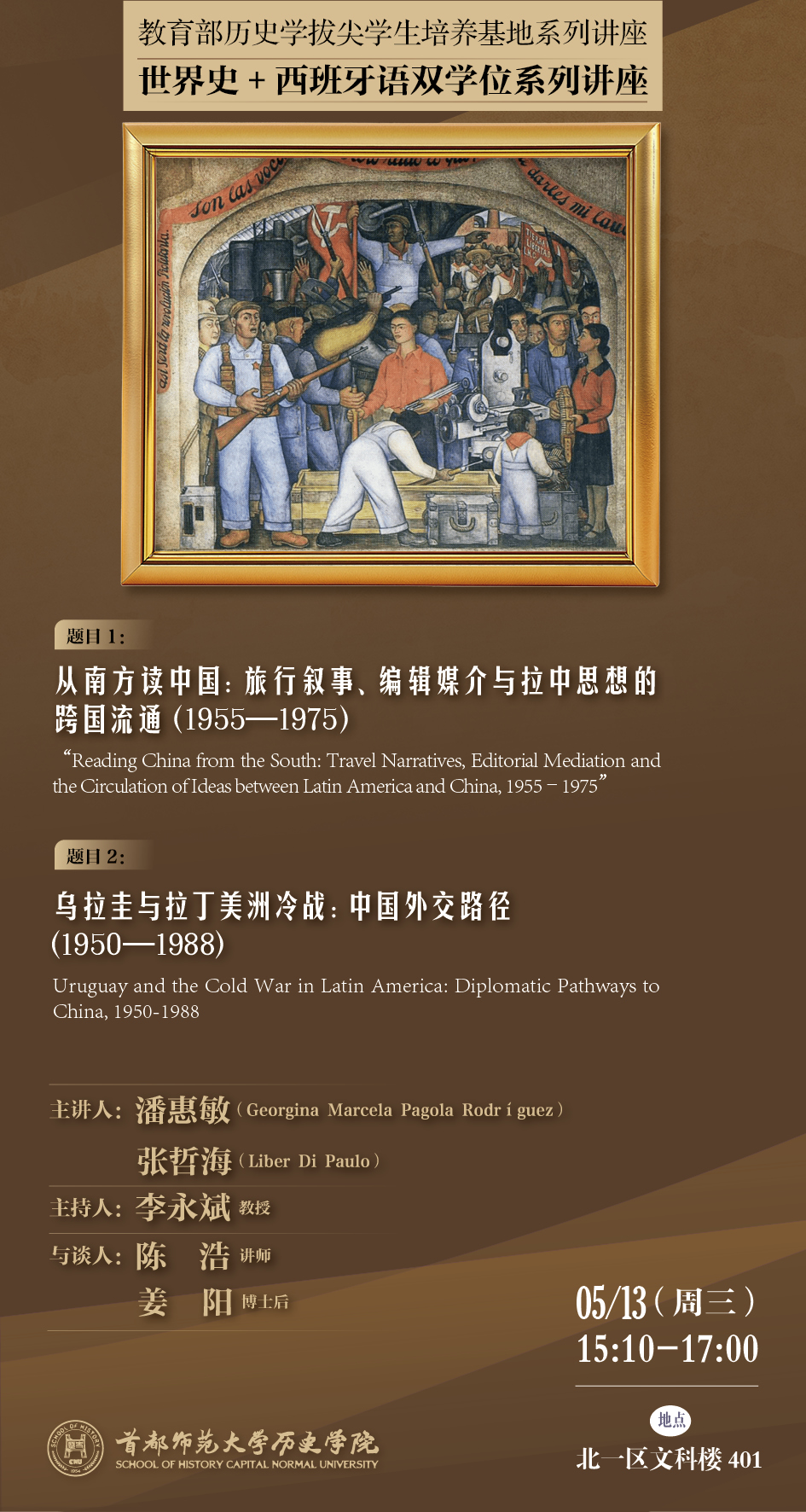
题目1:“Reading China from the South: Travel Narratives, Editorial Mediation and the Circulation of Ideas between Latin America and China, 1955–1975”
从南方读中国:旅行叙事、编辑媒介与拉中思想的跨国流通(1955–1975)
主讲人:Georgina Marcela Pagola Rodríguez (潘惠敏)
题目2:Uruguay and the Cold War in Latin America: Diplomatic Pathways to China, 1950-1988
乌拉圭与拉丁美洲冷战:中国外交路径 (1950–1988)
主讲人:Liber Di Paulo (张哲海)
时 间:5.13(周三)15:10-17:00
主持人:李永斌 教授
与谈人:陈浩 讲师 姜阳 博士后
地 点:北一区文科楼401
具体内容:
“Reading China from the South: Travel Narratives, Editorial Mediation and the Circulation of Ideas between Latin America and China, 1955–1975”
从南方读中国:旅行叙事、编辑媒介与拉中思想的跨国流通(1955–1975)
This lecture examines how Latin American intellectuals engaged with the People’s Republic of China during the Cold War through travel writing and grassroots cultural diplomacy. Focusing on Uruguay as a case study, it argues that South American actors produced a distinctive form of Third World political imagination by reading Chinese socialism from the vantage point of local struggles with development, socialism and anti-imperialism.
Drawing on Uruguayan travel narratives, memoirs and journalistic dispatches, the talk analyzes how individual experiences of the PRC were mediated by dense editorial networks-including the periodicals Marcha and Época, the Instituto Cultural Uruguay-China (Uruguay-China Cultural Association), and Nativa Libros bookstore- which selected, translated and debated Chinese revolutionary texts for audiences across the Southern Cone. Rather than treating travel writing as mere description, the lecture presents it as a mode of ideological translation through which foreign revolutions were adapted to local and regional political debates.
By foregrounding the interpretive labor of Uruguayan travelers such as Eduardo Galeano, Carlos María Gutiérrez and Jesualdo Sosa, the presentation demonstrates how ideas circulated across the Third World not through formal state channels alone, but through the testimonial and editorial practices of intellectuals embedded in transnational solidarities. While empirically grounded in Uruguay, the analysis offers a methodological and conceptual model for understanding how smaller Latin American nations actively reinterpreted Chinese socialism within their own political imaginaries.
本讲座探讨了冷战时期,拉丁美洲知识分子如何通过旅行写作和基层文化外交与中华人民共和国展开互动。以乌拉圭为案例,研究指出,南美行动者从自身的发展、社会主义与反帝斗争经验出发,解读中国社会主义,从而形成了一种独特的第三世界政治想象。
借助乌拉圭的旅行叙事、回忆录和新闻报道,讲座分析了个人在中国的经历如何经由密集的编辑网络——包括《进行曲》(Marcha)与《时代》(Época)期刊、乌拉圭—中国文化协会以及“本土书店”——进行中介传播。这些网络为南锥体地区的读者筛选、翻译并讨论中国的革命文本。讲座并不将旅行写作视为单纯的记录,而是将其呈现为一种意识形态转译的方式,通过这种方式,外国的革命经验得以被融入本地及区域的政治讨论之中。
通过聚焦爱德华多·加莱亚诺、卡洛斯·马里亚·古铁雷斯和赫苏阿尔多·索萨等乌拉圭旅行者的阐释性实践,本讲座展示了第三世界内部的思想流转,并非仅通过正式的国家渠道,而是借助跨国团结网络中的知识分子的见证写作与编辑实践。尽管以乌拉圭的经验为中心,这一分析为理解较小的拉美民族国家如何在其自身的政治想象中积极重新诠释中国社会主义,提供了一种方法论和概念模型。
Georgina Marcela Pagola Rodríguez (潘惠敏) will complete her PhD in Global Studies (World History) at the College of Liberal Arts, Shanghai University, in June 2026. She earned her BA in History Teaching at (IPA) Instituto de Profesores Artigas, Uruguay (2015), and her MA in Global Studies (World History) at Shanghai University (2022).
Her research focuses on the history of cultural exchanges between Uruguay and China from 1955 to 1975 in the framework of People’s Diplomacy. She has explored the travels of Uruguayan intellectuals and political militants to revolutionary China, as well as their travelogues. She is the author of articles published in Bulletin of Latin American Research and The Global Sixties.
She is currently a lecturer at FLACSO Uruguay (Facultad Latinoamericana de Ciencias Sociales), where she teaches in the postgraduate program “Understanding China: Culture, Philosophy and Historical Construction of the Asian Giant”. She is a member of the Latin American Association of Asian and African Studies (ALADAA), the Group of Asia-Latin American Studies of UDELAR (Universidad de la República), Uruguay, and the Regional Group of Latin American and Caribbean Research (GRILAC).
乔治娜·马塞拉·帕戈拉·罗德里格斯(潘惠敏)将于2026年6月在上海大学文学院获得全球学(世界史)博士学位。她于2015年获得乌拉圭阿蒂加斯师范学院的历史教学学士学位,并于2022年获得上海大学全球学(世界史)硕士学位。
她的研究聚焦于1955年至1975年间,在人民外交框架下乌拉圭与中国之间的文化交流史。她深入考察了乌拉圭知识分子和政治活动家前往革命中国的旅行及其所写的游记。她曾在《拉丁美洲研究公报》(Bulletin of Latin American Research)和《全球六十年代》(Global Sixties)期刊发表文章。
她目前担任乌拉圭拉丁美洲社会科学学院(FLACSO Uruguay)的讲师,在该校的”理解中国:亚洲巨人的文化、哲学与历史构建”研究生项目中任教。她是拉丁美洲亚非研究协会(ALADAA)、乌拉圭共和国大学(UDELAR)亚洲—拉美研究小组以及拉丁美洲和加勒比地区研究小组(GRILAC)的成员。
Uruguay and the Cold War in Latin America: Diplomatic Pathways to China, 1950-1988
乌拉圭与拉丁美洲冷战:中国外交路径 (1950–1988)
This lecture uses Uruguay as a lens to explore the Cold War in Latin America. Between 1950 and 1988, Uruguay’s foreign policy toward the People’s Republic of China unfolded in a context where formal diplomatic relations had not yet been established. What emerges is a gradual process of engagement through parliamentary debates, exploratory missions, trade initiatives, and symbolic gestures. These actions reflected Uruguay’s effort to diversify its external ties and to pursue autonomy in a world shaped by ideological polarization and U.S. hemispheric influence. Viewed through the framework of global history, Uruguay’s experience illustrates how smaller Latin American states participated in the reconfiguration of international order. The Cold War imposed constraints, but it also opened spaces through Third World solidarity and the rise of non aligned voices. China’s emergence as a postcolonial actor resonated in the Southern Cone, offering Uruguay an alternative framework for international integration. The study highlights how Uruguay’s engagement with China evolved from initial debates and exploratory contacts toward the gradual consolidation of diplomatic ties. The establishment of relations in 1988 was not a sudden decision but the culmination of decades of sustained initiatives and growing recognition of China as a relevant partner in Uruguay’s international strategy. Uruguay’s case demonstrates the interplay of ideology, economic interests, and strategic autonomy, offering insights into the historical foundations of Latin America–China relations and their place in global history.
本讲座以乌拉圭为切入点,探讨冷战时期的拉丁美洲。1950年至1988年间,乌拉圭对中华人民共和国的外交政策在一个尚未建立正式外交关系的背景下逐步展开。呈现出来的是一个通过议会辩论、考察团、贸易倡议和象征性姿态而逐步推进的接触过程。这些行动反映了乌拉圭在意识形态两极分化和美国西半球影响力的世界格局中,努力实现对外关系多元化、追求自主性的尝试。从全球史的视角来看,乌拉圭的经验展示了拉丁美洲中小国家如何参与国际秩序的重构。冷战固然带来了限制,但也通过第三世界团结和不结盟声音的兴起开辟了新的空间。中国作为一个后殖民行动者的崛起,在南锥体地区引起了共鸣,为乌拉圭提供了一种参与国际事务的替代框架。本研究重点指出,乌拉圭对华接触经历了从最初的辩论和探索性接触,到外交关系逐步巩固的过程。1988年两国建交并非一蹴而就的决定,而是持续数十年的努力,以及乌拉圭日益将中国视为其国际战略中重要合作伙伴的结果。乌拉圭的案例展现了意识形态、经济利益与战略自主之间的相互作用,为我们理解拉美—中国关系的历史基础及其在全球史中的位置提供了深刻的洞见。
Liber Di Paulo (张哲海) graduated as a History Teacher from the Instituto de Profesores Artigas (IPA) in Uruguay. He obtained a Diploma in Economic History at the Faculty of Social Sciences of the Universidad de la República (Udelar). He is currently completing his PhD in World History (Global Studies) at Shanghai University, where he also earned his Master’s degree in World History.
Since 2019 he has been based in Shanghai, dedicated to historical research on China-Latin America relations, with a focus on diplomacy, global history, South-South cooperation, and integration processes in the twentieth and twenty‑first centuries. His work combines historical analysis, global studies, and approaches to exchanges between Latin America and China.
He teaches in the postgraduate program “Understanding China: Culture, Philosophy, and Historical Construction of the Asian Giant” at FLACSO Uruguay, where he lectures on Chinese history, political thought, and international relations. He is a member of the academic groups GRILAC (Grupo de Reflexión sobre Integración y América Latina y el Caribe) and ALADAA Uruguay, through which he participates in research, outreach, and academic cooperation activities.
Liber has published in international peer‑reviewed journals such as India Quarterly, and has a forthcoming article accepted in Cold War History. He has also contributed to collective volumes and reports with academic presses in China and Latin America. His publications address topics including Sino‑Uruguayan relations, Latin America’s role in the Global South, and comparative perspectives on China-Latin America exchanges. His work has received recognition in China and Uruguay, including awards for research contributions.
利韦尔·迪保罗(张哲海)毕业于乌拉圭阿蒂加斯师范学院(IPA),获得历史教师资质,于乌拉圭共和国大学(Udelar)社会科学学院获得经济史文凭。目前正在上海大学攻读全球学(世界史)博士学位,并已在该校获得世界史硕士学位。
自2019年起,他定居上海,致力于中国与拉丁美洲关系的历史研究,重点关注二十世纪及二十一世纪的外交、全球史、南南合作以及一体化进程。他的研究将历史分析、全球学与拉美—中国交流路径相结合。
他在乌拉圭拉丁美洲社会科学学院(FLACSO Uruguay)的“理解中国:亚洲巨人的文化、哲学与历史建构”研究生项目中任教,讲授中国历史、政治思想及国际关系。他是拉美及加勒比一体化与反思学术团体(GRILAC)和乌拉圭拉美亚非研究协会(ALADAA)的成员,通过这些平台参与研究、推广及学术合作活动。
张哲海已在《印度季刊》(India Quarterly)等国际同行评审期刊上发表文章,并有一篇文章已被《冷战史》期刊接收,即将刊出。他还为中国和拉丁美洲的学术出版社的合著卷册和报告贡献了内容。他的出版物涉及中乌关系、拉丁美洲在全球南方中的角色以及中拉交流的比较视角等主题。其研究成果已在中国和乌拉圭获得认可,包括获得研究贡献方面的奖项。


