

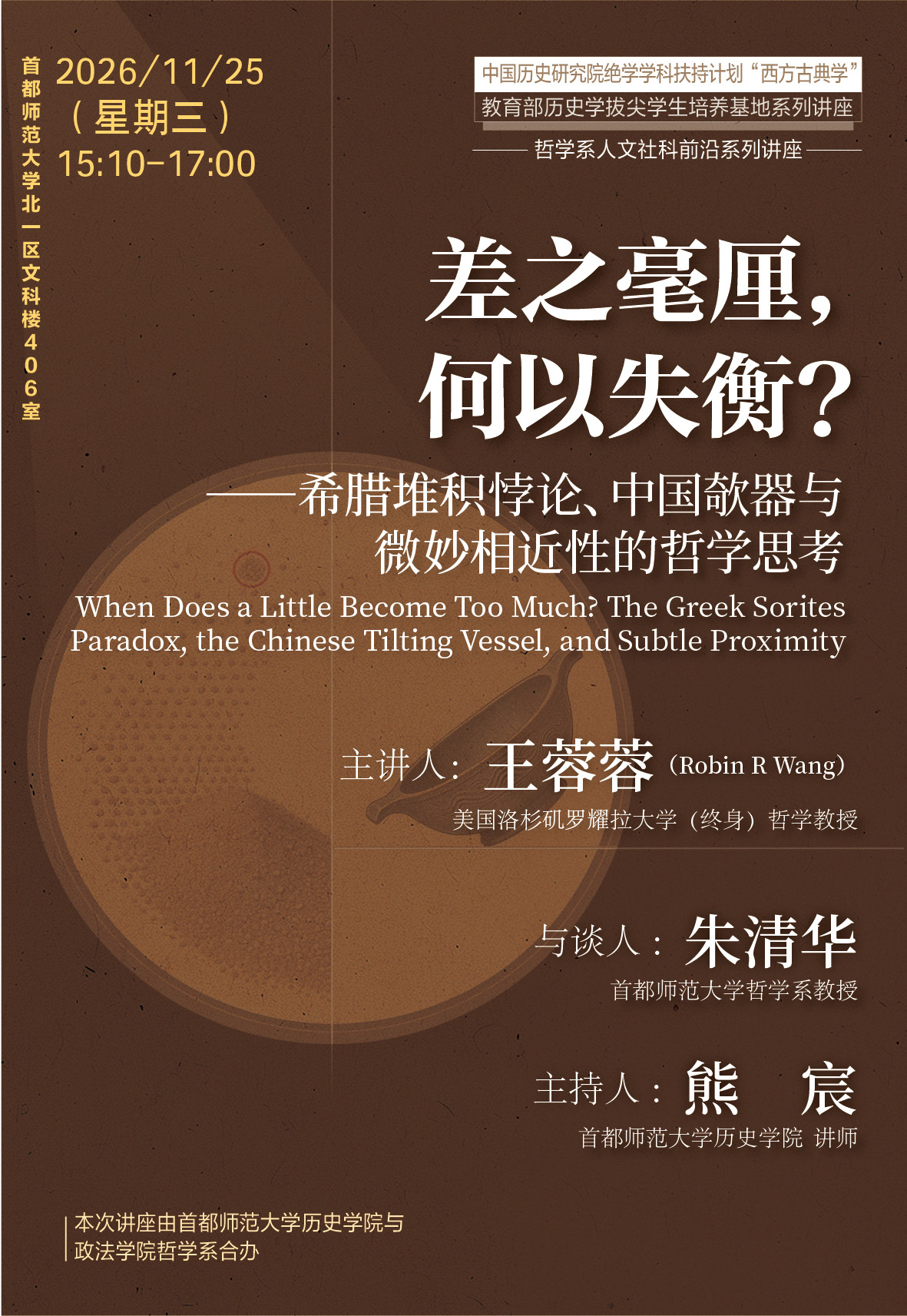
主讲人:美国洛杉矶罗耀拉大学(终身)哲学教授 王蓉蓉(Robin R Wang)
与谈人:首都师范大学哲学系教授 朱清华
主持人:首都师范大学历史学院讲师 熊宸
时 间:2026.11.25(周三)15:10-17:00
地 点:首都师范大学北一区文科楼406
主讲人简介:
王蓉蓉 (Robin R. Wang)
美国洛杉矶罗耀拉大学(终身)哲学教授。2016-17年斯坦福大学高等人类行为研究中心研究员。 2026 德国波恩大学访问教授。她获得北京大学哲学学士和硕士,美国圣母大学哲学硕士以及英国威尔斯大学哲学博士。她的教学与研究包括东西方比较哲学,道家思想,比较伦理学等。她的研究聚焦中国传统哲学思想的现代转型与全球对话,尤其在道家思想,女性哲学,比较哲学领域形成独特学术路径。作为现任世界哲学理事会(FISP)成员,她努力推动东方及多元哲学智慧在全球哲学领域中的话语权重构及影响,并主持多种国际研讨会和期刊专题,促进东西方哲学深度互鉴。她的著作有《阴阳与中国思想文化》剑桥大学出版社以及多篇学术论文。曾任全球亚洲与比较哲学协会会长 (2016-2018);现任国际中国哲学协会副会长,2028为会长。
Robin R. Wang is Professor of Philosophy at Loyola Marymount University, Los Angeles, Mercator Visiting Professor at Center for Science and Thought, University of Bonn, Germany (2026) and The Berggruen fellow (2016-17) at The Center for Advanced Study in the Behavioral Sciences (CASBS), Stanford University. Her teaching and research focus on Chinese and Comparative Philosophy, with particular expertise in Daoist philosophy. She is the author of the widely acclaimed book Yinyang: The Way of Heaven and Earth in Chinese Thought and Culture (Cambridge University Press, 2012), as well as several other influential publications. Beyond her scholarly contributions, she plays a leading role in the international philosophical community. Since 2018, she has served as a member of the Steering Committee of the Fédération Internationale des Sociétés de Philosophie (FISP), where she contributes to shaping the future of philosophical inquiry on a global scale. She currently serves as Vice President of the International Society of Chinese Philosophy (ISCP) and will become President of the Society in 2028.
与谈人简介:
朱清华
首都师范大学哲学系教授,博士生导师,首都师范大学哲学系外国哲学学科负责人。德国伍珀塔尔大学哲学系(2004-2005),美国华盛顿州立大学哲学系(2009)爱尔兰都柏林大学哲学学院(2017-1018),德国弗莱堡大学哲学系(2023-2024)访问学者。兼任中华全国外国哲学史学会理事,中国现象学专业委员会委员,德国哲学专业委员会委员,实践哲学专业委员会委员,古希腊罗马专业委员会副主任委员。国际海德格尔学会会员,国际柏拉图协会会员。主要研究领域为古希腊哲学、现象学,中西比较哲学等。主要著作有《回到源初的生存现象――海德格尔前期对亚里士多德的存在论诠释》等,译著有耶格尔的《亚里士多德:发展史纲要》,海德格尔的《巴门尼德》,《古代哲学的基本概念》《存在与真理》等,并在《哲学研究》、《哲学动态》等刊物发表论文50余篇,主持和参与教育部、国家社科基金项目多项。
讲座简介:
增加一粒沙子,何时会使一堆沙成为真正意义上的“沙堆”?再添一滴水,何时会使一个容器倾覆?这些看似简单的问题,却揭示了一个深刻的哲学难题:程度上的细微差异,如何转化为意义上的重大变化? 为什么有些微不足道的改变足以影响整个局面,而另一些变化却几乎不产生任何影响?本讲座将两种不同的哲学思想资源置于对话之中:古希腊的“堆积悖论”(Sorites Paradox)与中国传统中盈亏与平衡智慧的“欹器”。堆积悖论揭示了渐进变化中概念边界难以精确划定的问题;欹器则通过空则倾、中则正、满则覆的变化,展示了不同程度的盈亏如何改变整体结构的稳定状态。两者虽然关注点不同,却共同指向一个哲学的问题:定位、临界点与变化的条件之间究竟存在怎样的关系?本讲座基于中国哲学思想,提出“微妙相近性”(Subtle Proximity)。以探讨位置、间距、差异与转化之间的动态关系。微妙相近性超出从对立或互补来理解关系,发展出一种更为细致而深刻的关系性思维,并为理解当代科学、技术与数字世界中的复杂关联及其变化提供新的哲学视角。
When does one additional grain of sand turn a collection into a heap? When does one more drop of water cause a vessel to overturn? These seemingly simple questions raise a profound philosophical problem: How do differences of degree become differences of significance? Why can a seemingly insignificant change sometimes transform an entire situation, while other changes leave it largely unaffected? This lecture brings into conversation two distinctive philosophical resources: the ancient Greek Sorites paradox and the Chinese tilting vessel (欹器), traditionally associated with Confucian teachings on balance and excess. The Sorites paradox challenges the possibility of drawing precise boundaries within gradual change, while the tilting vessel illustrates how changing degrees of fullness can alter the stability of an entire configuration. Their differences illuminate a shared philosophical concern with degrees, thresholds, and the conditions under which change becomes consequential. Drawing further on early Chinese texts the lecture develops Subtle Proximity (微妙相近性) as a philosophical framework for understanding the dynamic relations among position, interval, difference, and transformation. Its central claim is that the significance of a difference cannot be determined by magnitude alone; it depends on its position within a changing relational configuration. Through the concepts of incipience (幾), subtlety (微), and conditioned emergence (因), Subtle Proximity reveals how small differences can reorganize the possibilities of stability, disruption, and renewal. This lecture argues that what matters is not simply how much has changed, but how changing degrees of proximity shape what can happen next. In this sense, Subtle Proximity offers a new way to understand the delicate conditions through which relationships are sustained, transformed, or undone.


